EXECUTIVE SUMMARY:
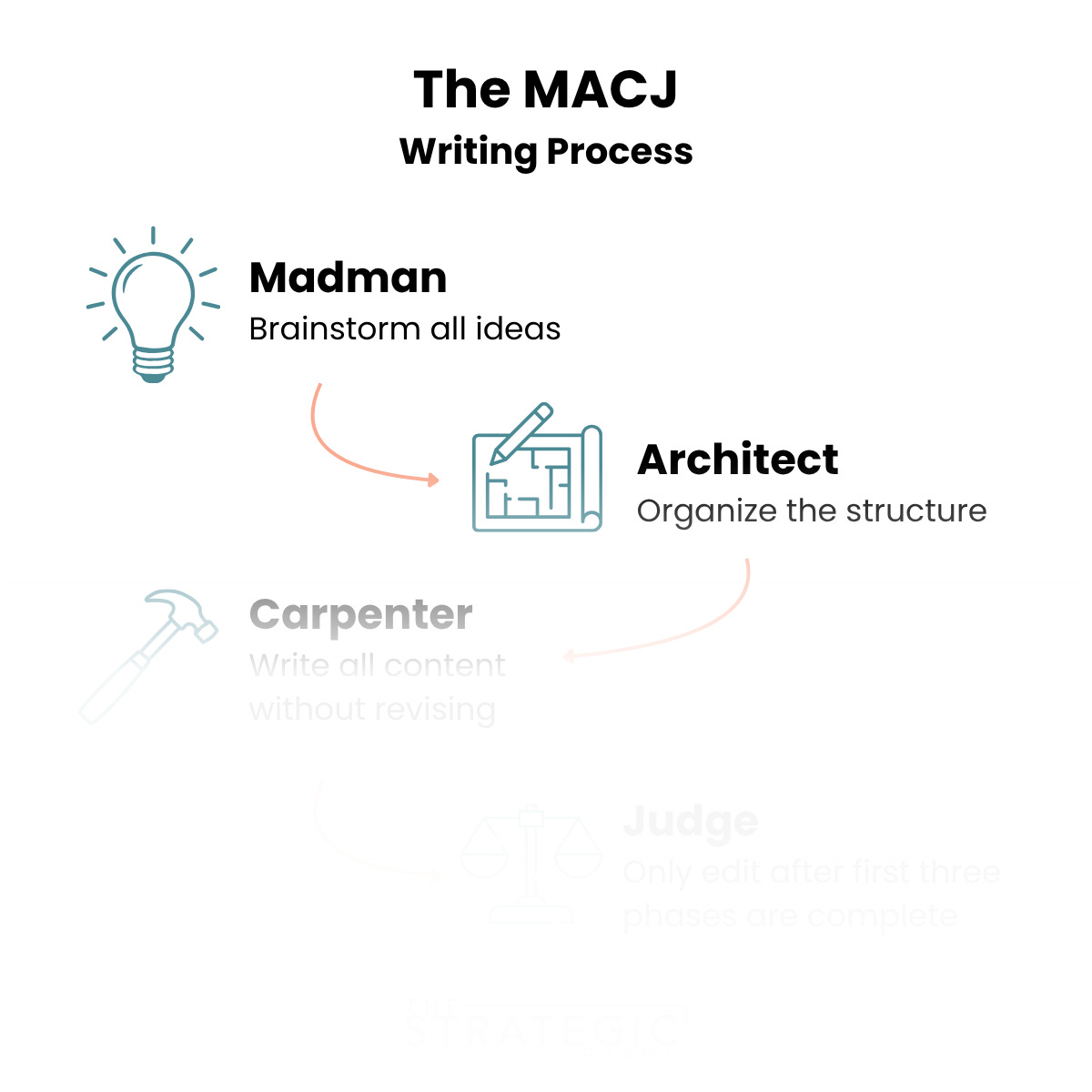
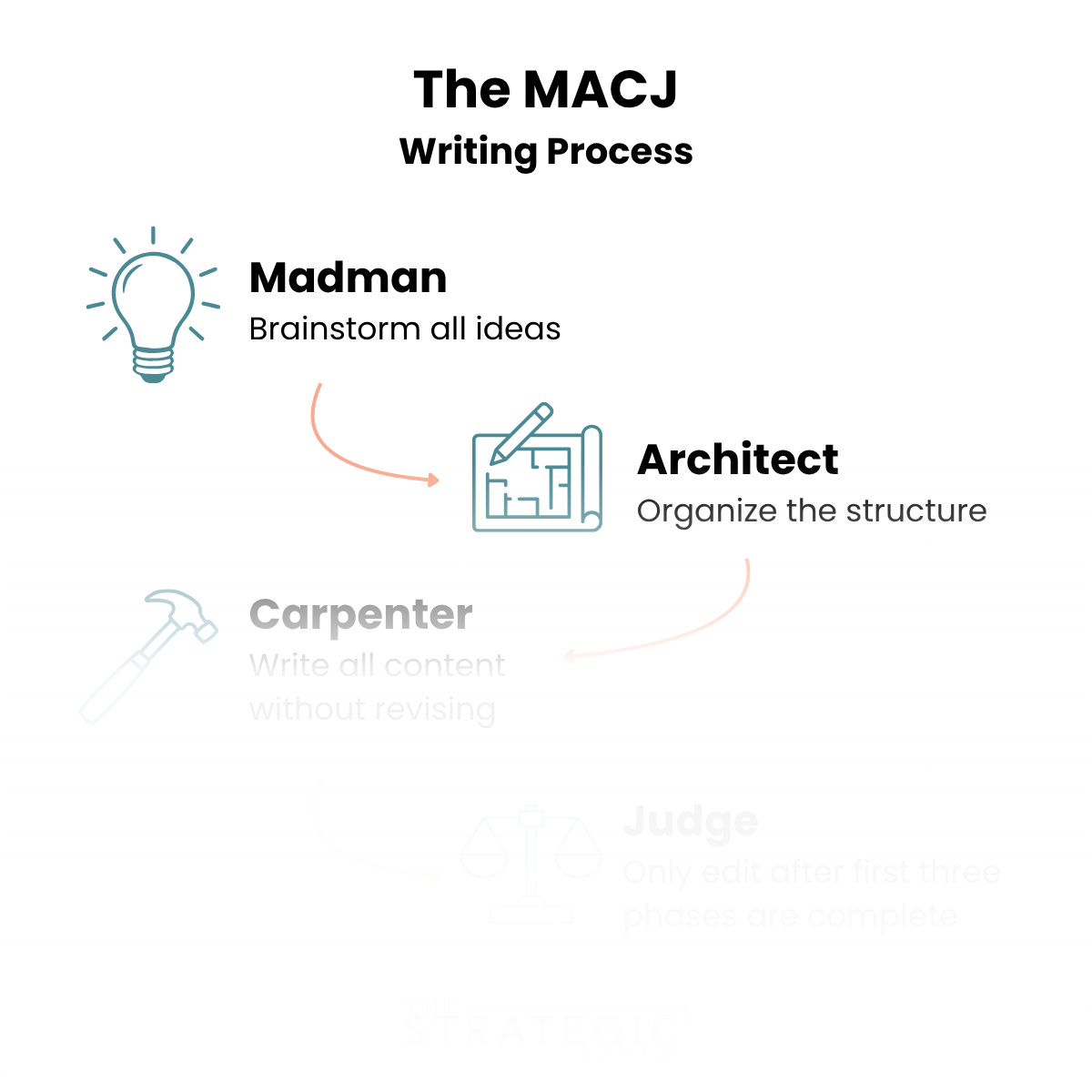
The MACJ process separates writing into four sequential roles: the Madman generates ideas, the Architect builds structure, the Carpenter drafts, and the Judge refines. Work through them in order, and the blank page stops being intimidating. I've used this for everything from short emails to my first business book, and it changed how much I produce and how good the result is.
This was the single most impactful lesson I learned at Harvard. What’s funny is I took an assessment and was permitted to not take the course, but I knew communication wasn’t one of my strengths, and I wanted it to be. So I took a class on business writing anyway.
And here’s what I learned. All good writers, whether they know it or not, follow a specific linear sequence in their writing process. Great writers don’t deviate from this, or it becomes far less efficient.
The process can be summarized into the MACJ writing process. This process has helped me write anything from a short email, to this article, to a full business book.
What is the MACJ Writing Process?
MACJ stands for the four essential “characters” you take on to complete a writing project: the Madman, the Architect, the Carpenter, and the Judge.
Madman: Every good piece of writing starts with chaos. This is the Madman phase. Your only job is to generate ideas. Capture everything that comes to mind: arguments, examples, stories, statistics, questions. Nothing needs to be logical. Nothing needs to be polished. In fact, it shouldn’t be. The biggest mistake people make is letting the Judge show up too early. The moment you start criticizing your ideas, creativity shuts down. The Madman’s job is simple: produce raw material.
Architect: Once you have ideas, the Architect steps in. The Architect organizes the chaos into structure. Which ideas belong together? What is the central argument? What order will make the most sense to the reader? Think of this stage as building the blueprint before constructing a house. A useful trick is to force yourself to identify the main points your piece will make. If you cannot summarize the argument in concise sentences, the structure probably isn’t clear yet. The Architect turns raw ideas into a plan.
Carpenter: Now the Carpenter gets to work. This is the drafting stage. The Carpenter follows the blueprint and builds the structure of the piece sentence by sentence. The key rule: write forward only. Do not edit. Do not re-read paragraphs. Do not obsess over word choice. Momentum matters more than perfection. A messy draft is infinitely more valuable than a perfect sentence that never gets finished. The Carpenter’s goal is progress.
Judge: Only after the draft is complete does the Judge arrive. The Judge edits, tightens, cuts unnecessary words, and clarifies the argument. Grammar gets fixed. Sentences get simplified. Weak sections get rewritten. This is where good writing becomes great writing. But the Judge must arrive last. When the Judge appears too early, the Madman stops producing ideas and the Carpenter stops building. That is how writer’s block happens.