
EXECUTIVE SUMMARY:
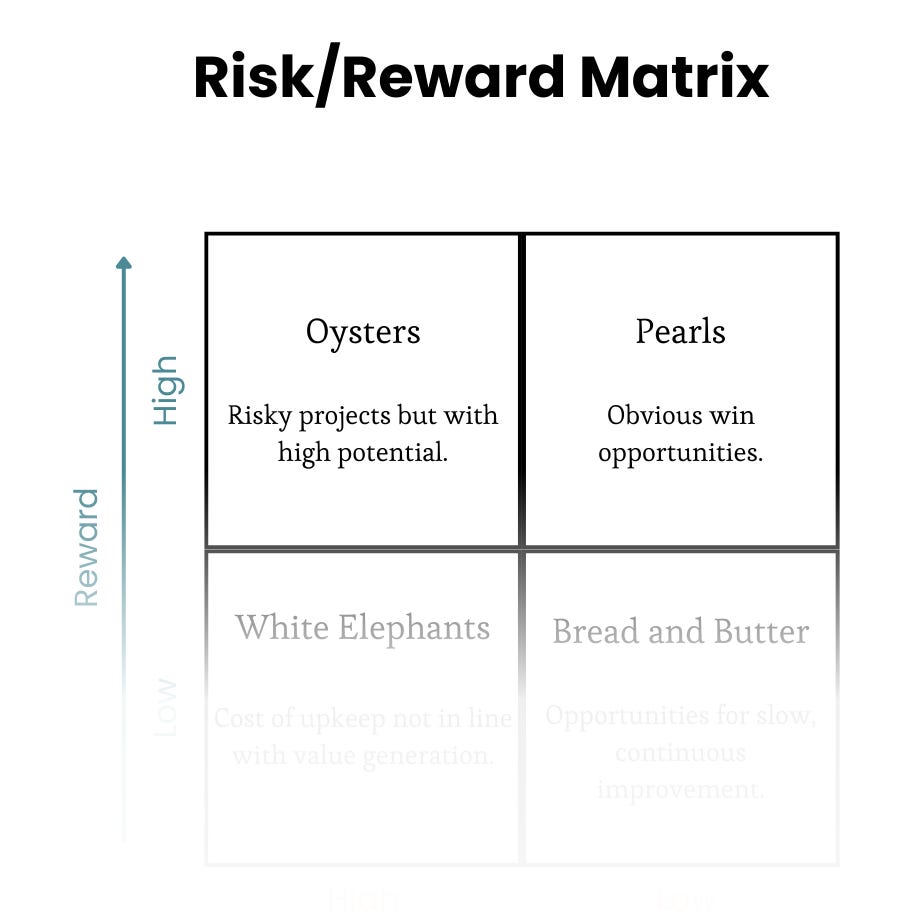
The Risk/Reward Matrix helps leaders evaluate opportunities by comparing potential payoff with the level of risk. It categorizes projects into four types: Oysters (high risk, high reward), Pearls (low risk, high reward), White Elephants (high risk, low reward), and Bread and Butter (low risk, low reward). By scoring and plotting initiatives on these two dimensions, organizations can see where to invest, scale, or divest, creating a balanced portfolio that blends innovation, growth, and stability.
In our recent articles on the 2x2 Matrix, BCG Matrix, and Eisenhower Matrix we explored how two simple variables can turn complexity into clarity. The Risk/Reward Matrix continues that series, but this time, the focus is on how to evaluate strategic opportunities.
This matrix is often used in innovation and investment decision-making, helping leaders determine which projects to fund, which to scale, and which to let go.
The origin of the quadrant names emerged in the 1980s and 1990s, though it is a bit unclear who originally developed and popularized them together in this framework. Many credit McKinsey & Company or the Mathesons in their book The Smart Organization.
What is the Risk/Reward Matrix